
K. Mathwig. ChemRxiv. 2024. doi:10.26434/chemrxiv-2024-hhnzs [pdf]
→ published in ACS Electrochem. (2024) DOI: 10.1021/acselectrochem.4c00166
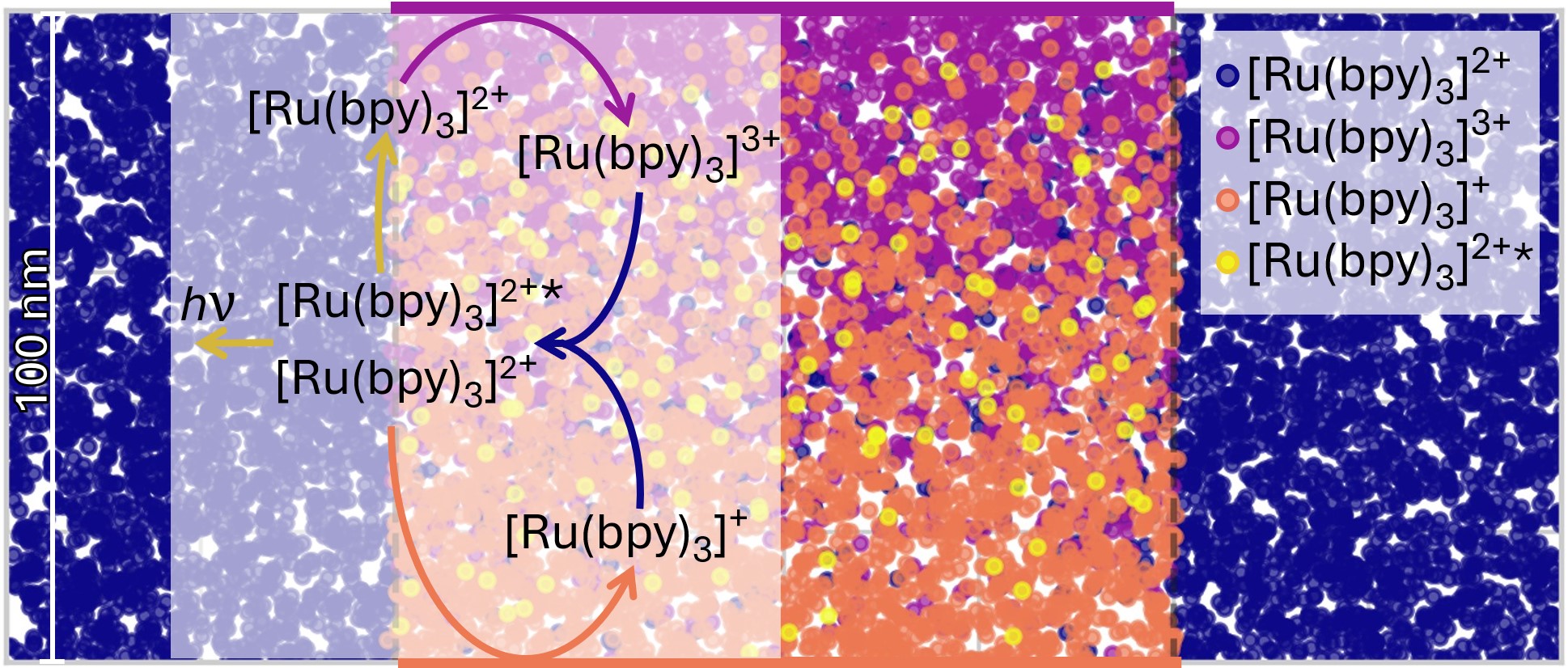
Electrochemiluminescence (ECL) is a vital analytical technique widely used in immunosensing and emerging applica-tions in biological imaging. Traditional ECL simulations rely on finite element methods, which provide valuable insights into reaction dynamics and spatial distribution of species. However, such methods are limited in mesoscopic environ-ments where stochastic effects become significant. Here, I present a novel approach using ChatGPTo1 to generate a Py-thon-based stochastic simulation for ECL reactions in a nanofluidic channel, incorporating diffusion, electrochemical and chemical reactions, and photon emission. The simulation successfully replicates results from finite element models while offering additional insights into time-dependent behaviors and enabling noise analysis for simulated luminescence traces. The iterative development of this simulation using ChatGPT was rapid, requiring minimal coding expertise while leveraging the model’s “reasoning” capabilities to implement physical principles, verify calculations, and optimize per-formance. This work demonstrates that large language models (LLMs) can serve as effective co-intelligence tools, facili-tating the development of complex simulations in electrochemistry. AI-driven tools/LLMs have a promising role in ad-vancing electrochemistry research, though careful validation remains essential to ensure scientific accuracy.
 Klaus Mathwig