
A. Y. Sadiq, T. Jahodová, E. R. Romero, L. Dragonetti, W. El Majdoub, S. Rieg, D. Hornuss, A. Soldà, W. Engelen, E. Benito-Peña, P. Purohit, R. Forster, K. Mathwig, V. Saggiomo, Giovanni Valenti, RSC Sensors & Diagnostics (2026). DOI: https://doi.org/10.1039/D6SD00152A
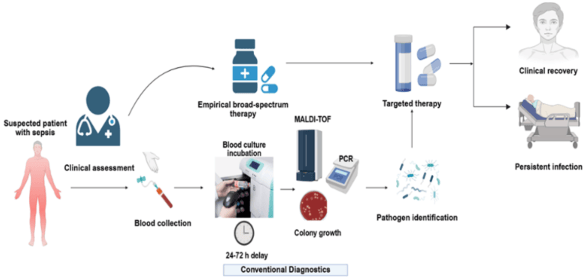
Sepsis early diagnosis and timely therapeutic stratification require rapid, sensitive, and clinically actionable analytical systems capable of detecting both pathogen-derived signals and host-response biomarkers directly in complex biological samples. However, effective sepsis diagnosis also requires consideration of multiple clinical and analytical parameters, including pathogen identity, host inflammatory status, disease severity, biomarker variability, sample complexity, and antimicrobial resistance, the latter becoming increasingly critical due to the growing emergence of drug-resistant infections. Here, we systematically review next-generation electrochemical sensing strategies for sepsis diagnosis, including nucleic acid-based genosensors for pathogen identification and antimicrobial resistance genes, aptamer- and antibody-based sensors for host biomarkers, and emerging recognition elements such as antibody fragments, nanobodies, peptides, and molecularly imprinted polymers. Advanced electrochemical transduction approaches are comprehensively discussed, covering impedance spectroscopy, voltammetry, square-wave voltammetry, and electrochemiluminescence, together with signal-enhancement and antifouling strategies based on nanocomposites, nanoparticles, microelectrodes, and peptide-based interfaces. Moreover, we highlight recent progress in the integration of electrochemical biosensors with microfluidic and point-of-care platforms for rapid sample processing, multiplexed detection, whole-blood analysis, portable instrumentation, and continuous monitoring. Particular attention is given to the remaining barriers that limit clinical translation, including low pathogen burden, biofouling in patient samples, sample-preparation requirements, device scalability, long-term stability, and validation in real sepsis cohorts. This review offers a practical and instructive reference for the rational design and further development of disposable, integrated, and clinically translatable electrochemical biosensing platforms for early sepsis diagnosis and personalized patient management.

