
H. Al-Kutubi, H. R. Zafarani, L. Rassaei and K. Mathwig, European Polymer Journal 83 (2016) 478, Special Issue “Redox Active Macromolecules”.
[link, pdf]
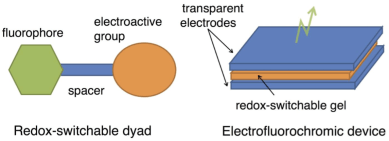 Electrofluorochromic molecules share the unique property that their fluorescence changes as a function of their oxidation state. This makes them interesting from a fundamental perspective as molecular dyads are designed and synthesized to tune the interplay of electrochemical and luminescent properties of molecules. Electrofluorochromic systems also find applications in sensing because a fluorescent signal can be detected with high sensitivity. Moreover, in the recent years the interest in redox-switchable fluorescent polymers has strongly increased due to their applicability in display devices. Here, we review electrofluorochromic molecules and polymers; we emphasize their structures and functional principles and point to specific applications.
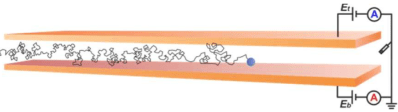
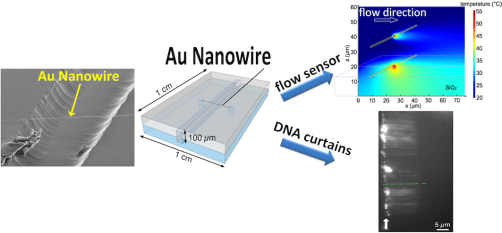 This paper describes the fabrication of millimeter-long gold nanowires that bisect the center of microfluidic channels. We fabricated the nanowires by nanoskiving and then suspended them over a trench in a glass structure. The channel was sealed by bonding it to a complementary poly(dimethylsiloxane) structure. The resulting structures place the nanowires in the region of highest flow, as opposed to the walls where it approaches zero, and expose their entire surface area to fluid. We demonstrate active functionality, by constructing a hot-wire anemometer to measure flow through determining the change in resistance of the nanowire as a function of heat dissipation at low voltage (< 5V). Further, passive functionality is demonstrated by visualizing individual, fluorescently labelled DNA molecules attached to the wires. We measure rates of flow and show that, compared to surface-bound DNA strands, elongation saturates at lower rates of flow and background fluorescence from non-specific binding is reduced.
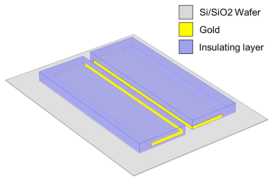 We propose a new geometry for nanogap electrochemical sensing devices. These devices consist of two closely spaced side-by-side electrodes which work under redox cycling conditions. Using finite element simulations, we investigate the effects of different geometric parameters on the redox cycling signal amplification to gain insight into the electrochemical sensing performance of the device design. This will allow optimizing the sensor performance of devices to be fabricated in the future.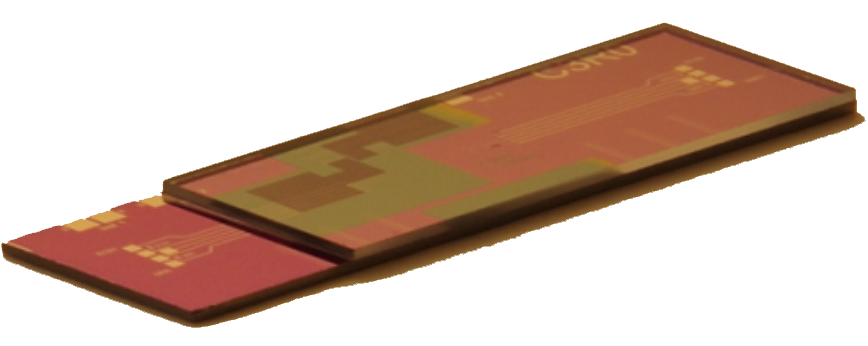

 Klaus Mathwig