
K. Mathwig, C. Fijen, M. Fontana, S. G. Lemay and J. Hohlbein, Procedia Technology 27 (2017) 141.
[link, pdf]
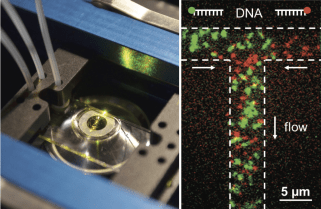 We introduce a nanofluidic mixing device entirely fabricated in glass for the fluorescence detection of single molecules. The design consists of a nanochannel T-junction and allows the continuous monitoring of chemical or enzymatic reactions of analytes as they arrive from two independent inlets. The fluorescently labeled molecules are tracked before, during and after they enter the mixing region, and their reactions with each other are observed by means of optical readout such as Förster Resonance Energy Transfer (FRET). Our method can be used for analyzing the kinetics of DNA annealing in a high-parallelized fashion.
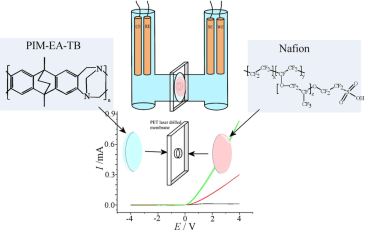 Ionic diode phenomena occur at asymmetric ionomer | aqueous electrolyte microhole interfaces. Depending on the applied potential, either an “open” or a “closed” diode state is observed switching between a high ion flow rate and a low ion flow rate. Physically, the “open” state is associated mainly with conductivity towards the microhole within the ionomer layer and the “closed” state is dominated by restricted diffusion-migration access to the microhole interface opposite to the ionomer. In this report we explore a “heterojunction” based on an asymmetric polymer of intrinsic microporosity (PIM) | Nafion ionomer microhole interface. Improved diode characteristics and current rectification are observed in aqueous NaCl. The effects of creating the PIM | Nafion micro-interface are investigated and suggested to lead to novel sensor architectures.
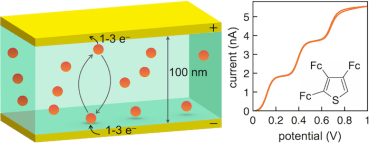
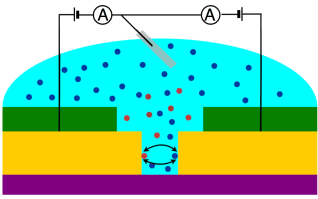 We report a strategy for the fabrication of a new type of electrochemical nanogap transducer. These nanogap devices are based on signal amplification by redox cycling. Using two steps of electron-beam lithography, vertical gold electrodes are fabricated side by side at a 70 nm distance encompassing a 20 attoliter open nanogap volume. We demonstrate a current amplification factor of 2.5 as well as the possibility to detect the signal of only 60 analyte molecules occupying the detection volume. Experimental voltammetry results are compared to calculations from finite element analysis.
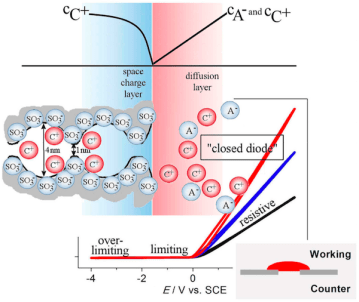 A thin film of Nafion®, of approximately 5 µm thickness, asymmetrically deposited onto a 6 µm thick film of poly(ethylene terephthalate) (PET) fabricated with a 5, 10, 20, or 40 µm microhole, is shown to exhibit prominent ionic diode behaviour involving cation charge carrier (“cationic diode”). The phenomenon is characterized via voltammetric, chronoamperometric, and impedance methods. Phenomenologically, current rectification effects are comparable to those observed in nano-cone devices where space-charge layer effects dominate. However, for microhole diodes a resistive, a limiting, and an over-limiting potential domain can be identified and concentration polarization in solution is shown to dominate in the closed state
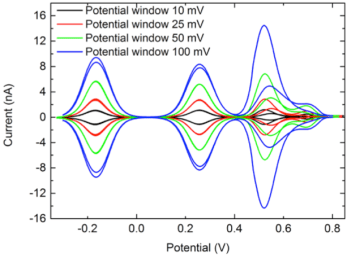 Interference or crosstalk of coexisting redox species results in overlapping of electrochemical signals, and it is a major hurdle in sensor development. In nanogap sensors, redox cycling between two independently biased working electrodes results in an amplified electrochemical signal and an enhanced sensitivity. Here, we report new strategies for selective sensing of three different redox species in a nanogap sensor of a two femtoliter volume. Our approach relies on modulating the electrode potentials to define specific potential windows between the two working electrodes; consequently, specific detection of each redox species is achieved. Finite element modelling is employed to simulate the electrochemical processes in the nanogap sensor, and the results are in good agreement with those of experiments.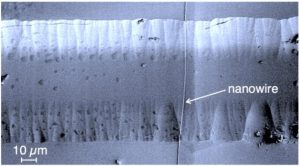
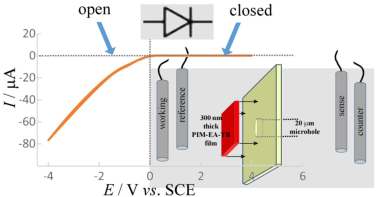 “Ionic diode” (or current rectification) effects are potentially important for a range of applications including water purification. In this preliminary report, we observe novel ionic diode behaviour of thin (300 nm) membranes based on a polymer of intrinsic microporosity (PIM-EA-TB) supported on a poly-ethylene-terephthalate (PET) film with a 20 μm diameter microhole, and immersed in aqueous electrolyte media. Current rectification effects are observed for half-cells with the same electrolyte solution on both sides of the membrane for cases where cation and anion mobility differ (HCl, other acids, NaOH, etc.) but not for cases where cation and anion mobility are more alike (LiCl, NaCl, KCl, etc.). A pH-dependent reversal of the ionic diode effect is observed and discussed in terms of tentatively assigned mechanisms based on both (i) ion mobility within the PIM-EA-TB nano-membrane and (ii) a possible “mechanical valve effect” linked to membrane potential and electrokinetic movement of the membrane as well as hydrostatic pressure effects.
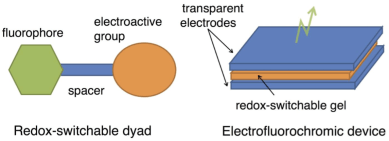 Electrofluorochromic molecules share the unique property that their fluorescence changes as a function of their oxidation state. This makes them interesting from a fundamental perspective as molecular dyads are designed and synthesized to tune the interplay of electrochemical and luminescent properties of molecules. Electrofluorochromic systems also find applications in sensing because a fluorescent signal can be detected with high sensitivity. Moreover, in the recent years the interest in redox-switchable fluorescent polymers has strongly increased due to their applicability in display devices. Here, we review electrofluorochromic molecules and polymers; we emphasize their structures and functional principles and point to specific applications.
 Klaus Mathwig