Review Article

K. Mathwig, T. J. Aartsma, G. W. Canters and S. G. Lemay
Nanoscale Methods for Single-Molecule Electrochemistry
Annual Review of Analytical Chemistry 7 (2014) 383.
[pdf]

annurevtocThe development of experiments capable of probing individual molecules has led to major breakthroughs in fields ranging from molecular electronics to biophysics, allowing direct tests of knowledge derived from macroscopic measurements and enabling new assays that probe population heterogeneities and internal molecular dynamics. Although still partly in their infancy, such methods are also being developed for probing molecular systems in solution using electrochemical transduction mechanisms. Here we outline the present status of this emerging field, concentrating in particular on optical methods, metal molecule metal junctions, and electrochemical nanofluidic devices.

Journal Article

E. Kätelhön, K. J. Krause, K. Mathwig, S. G. Lemay and B. Wolfrum
Noise Phenomena Caused by Reversible Adsorption in Nanoscale Electrochemical Devices
ACS Nano 8 (2014) 4924.
[pdf]

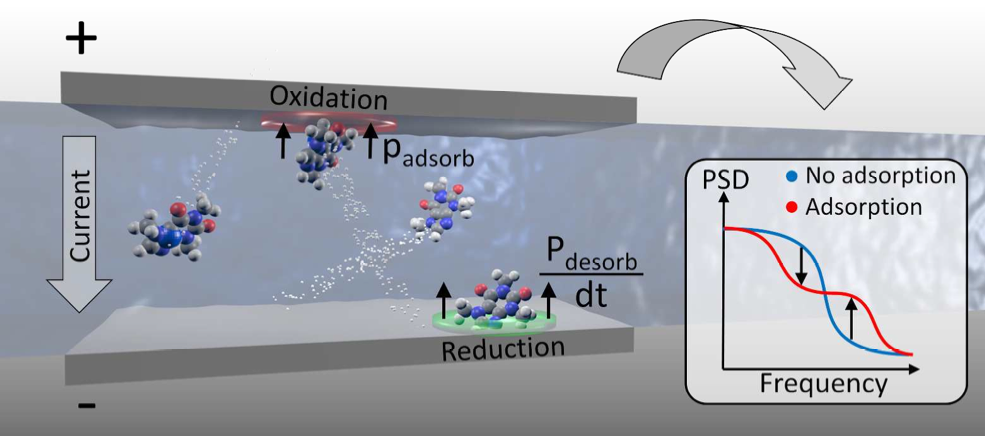
toc_noise_phenomenaWe theoretically investigate reversible adsorption in electrochemical devices on a molecular level. To this end, a computational framework is introduced, which is based on 3D random walks including probabilities for adsorption and desorption events at surfaces. We demonstrate that this approach can be used to investigate adsorption phenomena in electrochemical sensors by analyzing experimental noise spectra of a nanofluidic redox cycling device. The evaluation of simulated and experimental results reveals an upper limit for the average adsorption time of ferrocene dimethanol of ~200 μs. We apply our model to predict current noise spectra of further electrochemical experiments based on interdigitated arrays and scanning electrochemical microscopy. Since the spectra strongly depend on the molecular adsorption characteristics of the detected analyte, we can suggest key indicators of adsorption phenomena in noise spectroscopy depending on the geometric aspect of the experimental setup.

Journal Article

D. Mampallil, K. Mathwig, S. Kang and S. G. Lemay
Reversible Adsorption of Outer-Sphere Redox Molecules at Pt Electrodes
The Journal of Physical Chemistry Letters 5 (2014) 636.
[pdf]

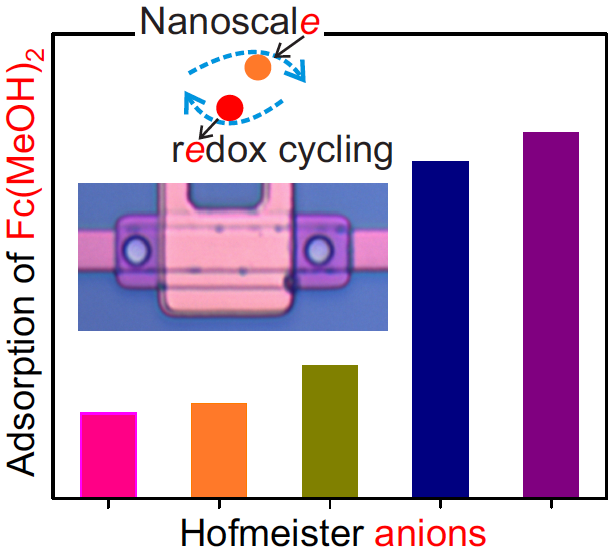
tocjpclettAdsorption often dominates the response of nanofluidic systems due to their high surface-to-volume ratios. Here we harness this sensitivity to investigate the reversible adsorption of outer-sphere redox species at electrodes, a phenomenon that is easily overlooked in bulk measurements. We find that, even though adsorption does not necessarily play a role in the electron-transfer process, such adsorption is nevertheless ubiquitous for the widely used outer-sphere species. We investigate the physical factors driving adsorption and find that this counter-intuitive behavior is mediated by the anionic species in the supporting electrolyte, closely following the well-known Hofmeister series. Our results provide foundations both for theoretical studies of the underlying mechanisms and for contriving strategies to control adsorption in micro/nanoscale electrochemical transducers where surface effects are dominant.

Journal Article

S. Kang, A. F. Nieuwenhuis, K. Mathwig, D. Mampallil and S. G. Lemay
Electrochemical Single-Molecule Detection in Aqueous Solution using Self-Aligned Nanogap Transducers
ACS Nano 7 (2013) 10931.
[pdf]

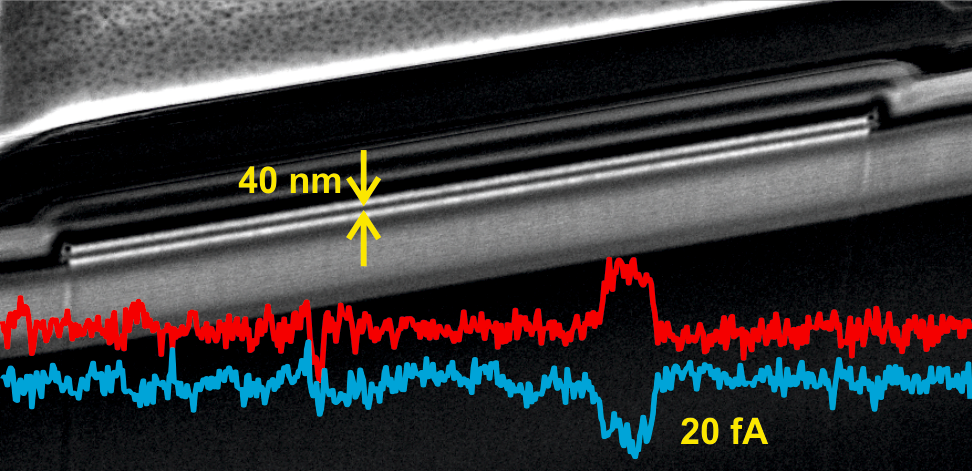
toc_aqueous Electrochemical detection of individual molecular tags in nanochannels may enable cost effective, massively parallel analysis and diagnostics platforms. Here we demonstrate single-molecule detection of prototypical analytes in aqueous solution based on redox cycling in 40 nm nanogap transducers. These nanofluidic devices are fabricated using standard microfabrication techniques combined with a self-aligned approach that minimizes gap size and dead volume. We demonstrate the detection of three common redox mediators at physiological salt concentrations.

Conference Proceedings

K. Mathwig, S. Schlautmann, S. G. Lemay and J. Hohlbein
A Novel Parallel Nanomixer for High-Throughput Single-Molecule Fluorescence Detection
Proceedings of the 17th International Conference on Miniaturized Systems for Chemistry and Life Science, Freiburg, Germany, Oct. 27 – 31 (2013) 1385.
[pdf]

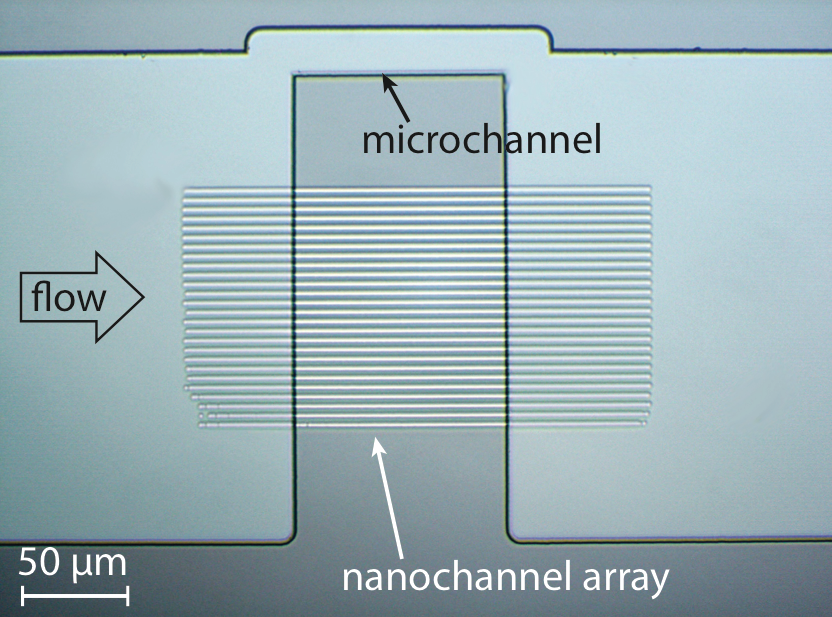
MicroTAS2013This paper introduces a novel fluidic device based on syringe-driven flow of fluorescent species through a parallel array of nanochannels, in which the geometrical confinement enables long observation times of non-immobilized molecules. Extremely low flow rates are achieved by operating the array of nanochannels in parallel with a larger microchannel. The addition of a second microfluidic inlet allows for mixing different species in a well-defined volume, enabling the study of irreversible reactions such as DNA synthesis in real-time using single-molecule fluorescence resonance energy transfer. Devices are fabricated in glass with the purpose of high-throughput single-molecule fluorescence detection.

Journal Article

K. Mathwig and S. G. Lemay
Mass transport in electrochemical nanogap sensors
Electrochimica Acta 112 (2013) 943.
[pdf]

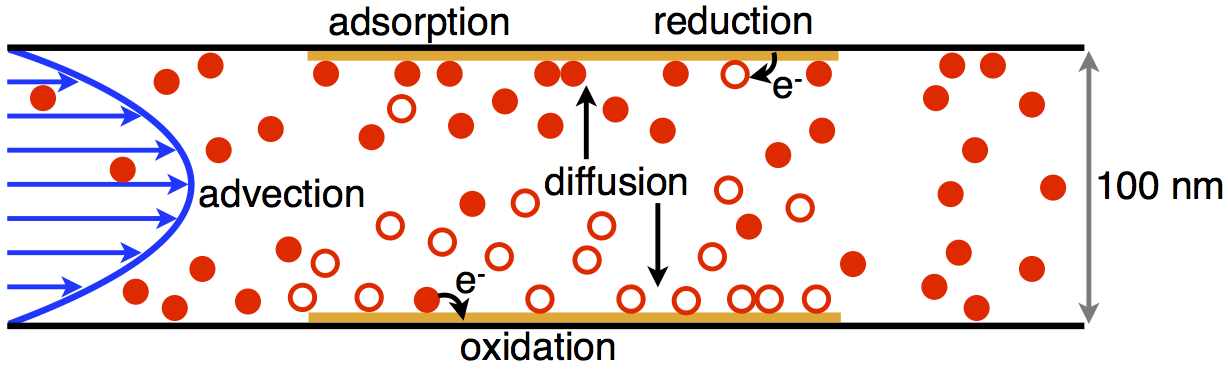
TOC_electrochimica_actaNanofluidic thin-layer cells based on redox cycling allow for extremely sensitive electrochemical detection. Here we establish a physical mass-transfer model for analyte molecules in these transducers which takes into account advective and diffusive transport of both oxidized and reduced species as well as reversible dynamic adsorption at the sensor surfaces. We use finite-element modeling to determine the transient response of nanogap sensors; numerically we predict that the response time can be reduced substantially by pressure-driven advection while the faradaic limiting current remains unaffected by this flow for all experimentally accessible flow rates.

Journal Article

D. Mampallil, K. Mathwig, S. Kang and S. G. Lemay
Redox couples with unequal diffusion coefficients: effect on redox cycling
Analytical Chemistry 85 (2013) 6053.
[pdf]

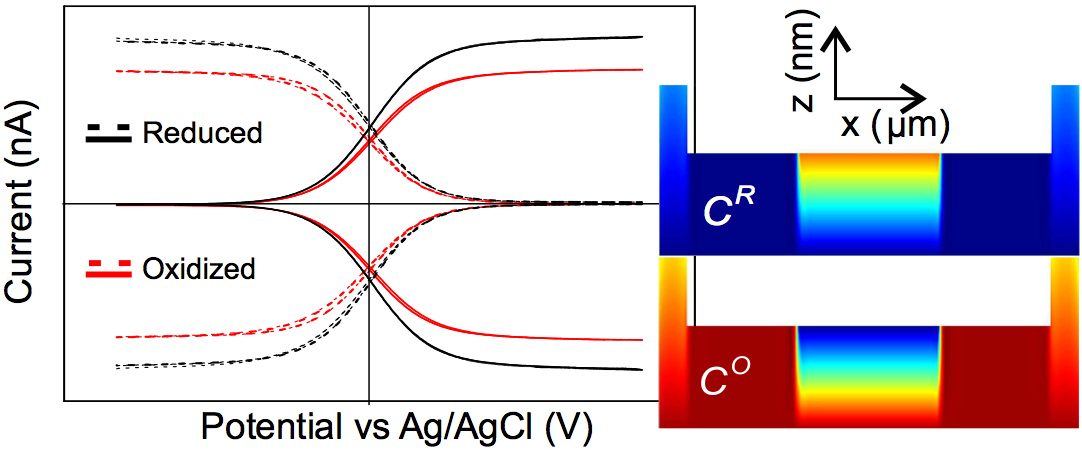
TOC_FcFcplus Redox cycling between two electrodes separated by a narrow gap allows dramatic amplification of the faradaic current. Unlike conventional electrochemistry at a single electrode, however, the mass-transport-limited current is controlled by the diffusion coefficient of both the reduced and oxidized forms of the redox-active species being detected and, counter-intuitively, by the redox state of molecules in the bulk solution outside the gap itself. Using a combination of finite-element simulations, analytical theory and experimental validation, we elucidate the interplay between these interrelated factors. In so doing we generalize previous results obtained in the context of scanning electrochemical microscopy and obtain simple analytical results that are generally applicable to experimental situations where efficient redox cycling takes place.

Journal Article

K. Mathwig and S. G. Lemay
Pushing the Limits of Electrical Detection of Ultralows Flows in Nanofluidic Channels
Micromachines 4 (2013) 138.
Special Issue Selected papers from 1st International Conference on Microfluidic Handling Systems.
[pdf]

micromachinesTOC2This paper presents improvements in flow detection by electrical cross-correlation spectroscopy. This new technique detects molecular number fluctuations of electrochemically active analyte molecules as they are transported by liquid flow through a nanochannel. The fluctuations are used as a marker of liquid flow as their time of flight in between two consecutive transducers is determined, thereby allowing for the measurement of liquid flow rates in the picoliter-per-minute regime. Here we show an enhanced record-low sensitivity below 1 pL/min by capitalizing on improved electrical instrumentation, an optimized sensor geometry and a smaller channel cross section. We further discuss the impact of sensor geometry on the cross-correlation functions.

Review Article

S. G. Lemay, S. Kang, K. Mathwig and P. S. Singh
Single-Molecule Electrochemistry: Present Status and Outlook
Accounts of Chemical Research 46 (2013) 369.
[pdf]
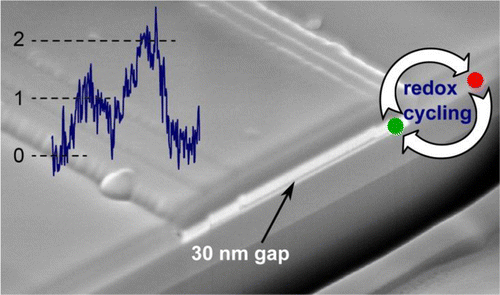
accountsThe development of methods for detecting and manipulating matter at the level of individual macromolecules represents one of the key scientific advancements of recent decades. These techniques allow us to get information that is largely unobtainable otherwise, such as the magnitudes of microscopic forces, mechanistic details of catalytic processes, macromolecular population heterogeneities, and time-resolved, step-by-step observation of complex kinetics. Methods based on optical, mechanical, and ionic-conductance signal transduction are particularly developed. However, there is scope for new approaches that can broaden the range of molecular systems that we can study at this ultimate level of sensitivity and for developing new analytical methods relying on single-molecule detection. Approaches based on purely electrical detection are particularly appealing in the latter context, since they can be easily combined with microelectronics or fluidic devices on a single microchip to create large parallel assays at relatively low cost.

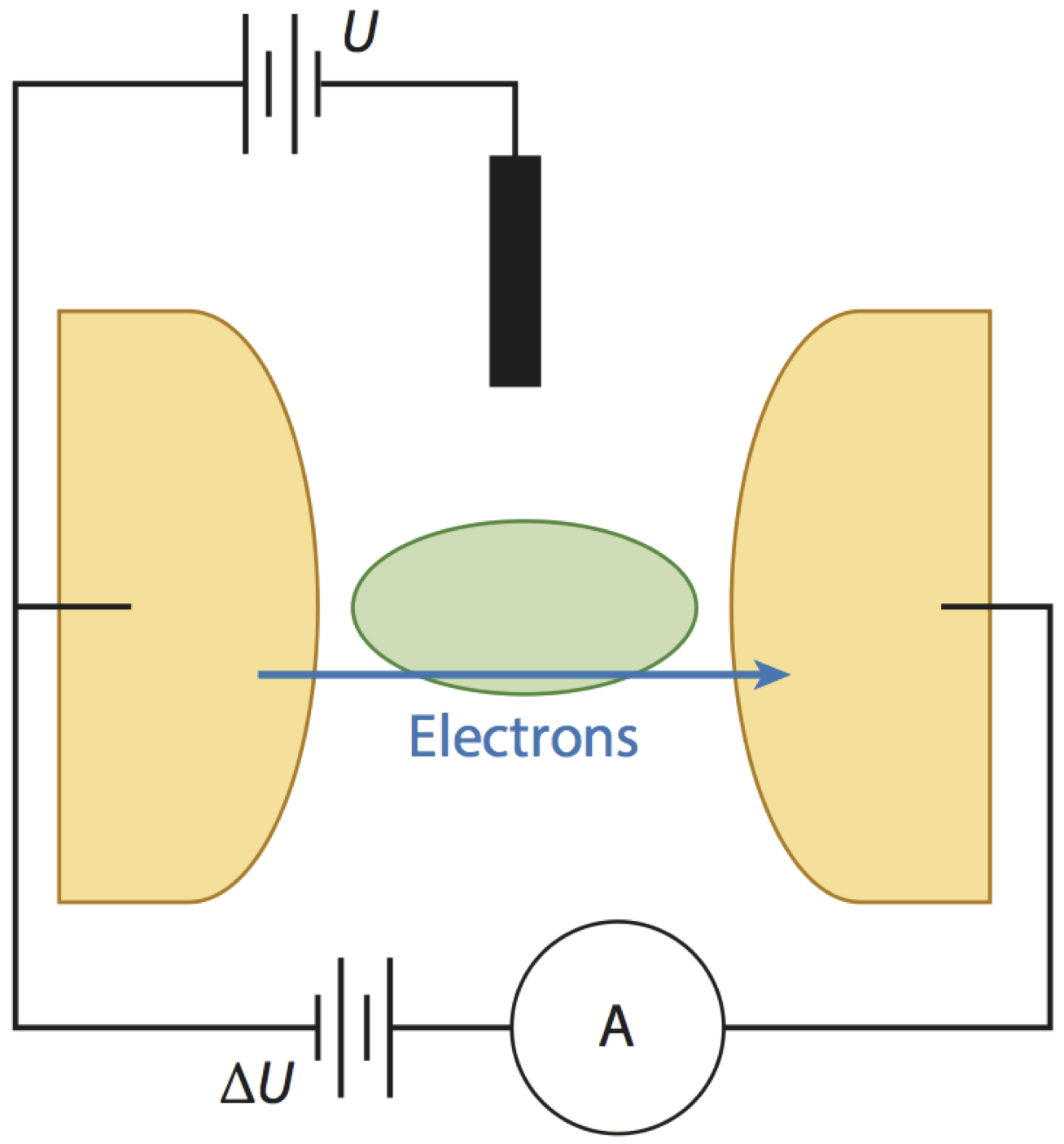
A form of electrical signal transduction that has so far remained relatively underdeveloped at the single-molecule level is the direct detection of the charge transferred in electrochemical processes. The reason for this is simple: only a few electrons are transferred per molecule in a typical faradaic reaction, a heterogeneous charge-transfer reaction that occurs at the electrode’s surface. Detecting this tiny amount of charge is impossible using conventional electrochemical instrumentation. A workaround is to use redox cycling, in which the charge transferred is amplified by repeatedly reducing and oxidizing analyte molecules as they randomly diffuse between a pair of electrodes. For this process to be sufficiently efficient, the electrodes must be positioned within less than 100 nm of each other, and the analyte must remain between the electrodes long enough for the measurement to take place. Early efforts focused on tip-based nanoelectrodes, descended from scanning electrochemical microscopy, to create suitable geometries. However, it has been challenging to apply these technologies broadly.

In this Account, we describe our alternative approach based on electrodes embedded in microfabricated nanochannels, so-called nanogap transducers. Microfabrication techniques grant a high level of reproducibility and control over the geometry of the devices, permitting systematic development and characterization. We have employed these devices to demonstrate single-molecule sensitivity. This method shows good agreement with theoretical analysis based on the Brownian motion of discrete molecules, but only once the finite time resolution of the experimental apparatus is taken into account. These results highlight both the random nature of single-molecule signals and the complications that it can introduce in data interpretation. We conclude this Account with a discussion on how scientists can overcome this limitation in the future to create a new experimental platform that can be generally useful for both fundamental studies and analytical applications.

Journal Article

P. S. Singh, E. Kätelhön, K. Mathwig, B. Wolfrum and S. G. Lemay
Stochasticity in Single-Molecule Nanoelectrochemistry: Origins, Consequences, and Solutions
ACS Nano 6 (2012) 9662.
[pdf]

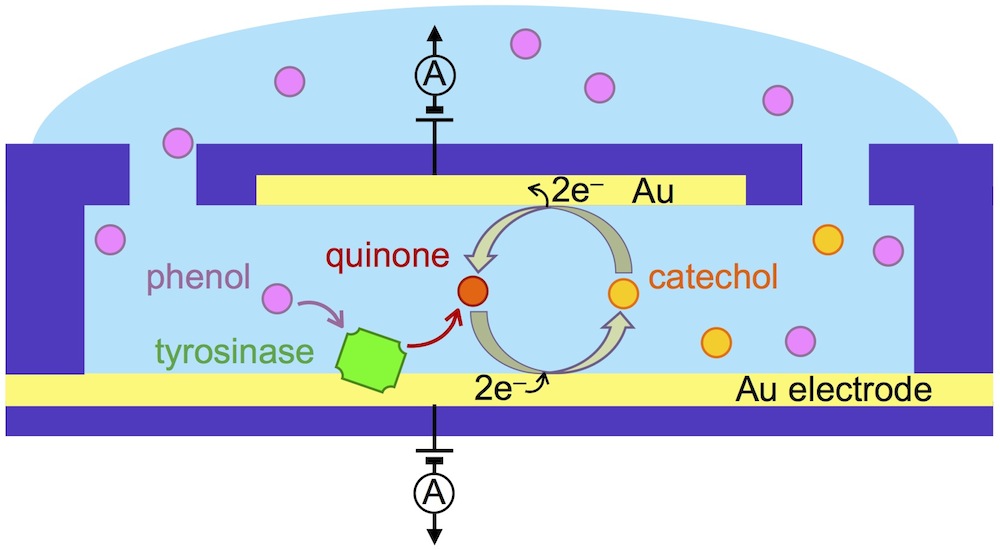
Electrochemical detection of single molecules is being actively pursued as an enabler of new fundamental experiments and sensitive analytical capabilities. Most attempts to date have relied on redox cycling in a nanogap, which consists of two parallel electrodes separated by a nanoscale distance. While these initial experiments have demonstrated single-molecule detection at the proof-of-concept level, several fundamental obstacles need to be overcome to transform the technique into a realistic detection tool suitable for use in more complex settings (e.g., studying enzyme dynamics at single catalytic event level, probing neuronal exocytosis, etc.). In particular, it has become clearer that stochasticity—the hallmark of most single-molecule measurements—can become the key limiting factor on the quality of the information that can be obtained from single-molecule electrochemical assays. Here we employ random-walk simulations to show that this stochasticity is a universal feature of all single-molecule experiments in the diffusively coupled regime and emerges due to the inherent properties of Brownian motion. We further investigate the intrinsic coupling between stochasticity and detection capability, paying particular attention to the role of the geometry of the detection device and the finite time resolution of measurement systems. We suggest concrete, realizable experimental modifications and approaches to mitigate these limitations. Overall, our theoretical analyses offer a roadmap for optimizing single-molecule electrochemical experiments, which is not only desirable but also indispensable for their wider employment as experimental tools for electrochemical research and as realistic sensing or detection systems.