Conference Proceedings

K. Mathwig, D. Mampallil, S. Kang and S. G. Lemay
Detection of Sub-Picoliter-per-Minute Flows by Electrochemical Autocorrelation Spectroscopy
Proceedings of the 16th International Conference on Miniaturized Systems for Chemistry and Life Science, Okinawa, Japan, Oct. 28 – Nov. 1 (2012) 28.
[pdf]

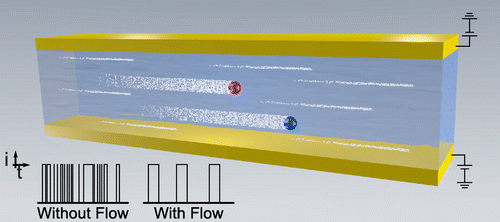
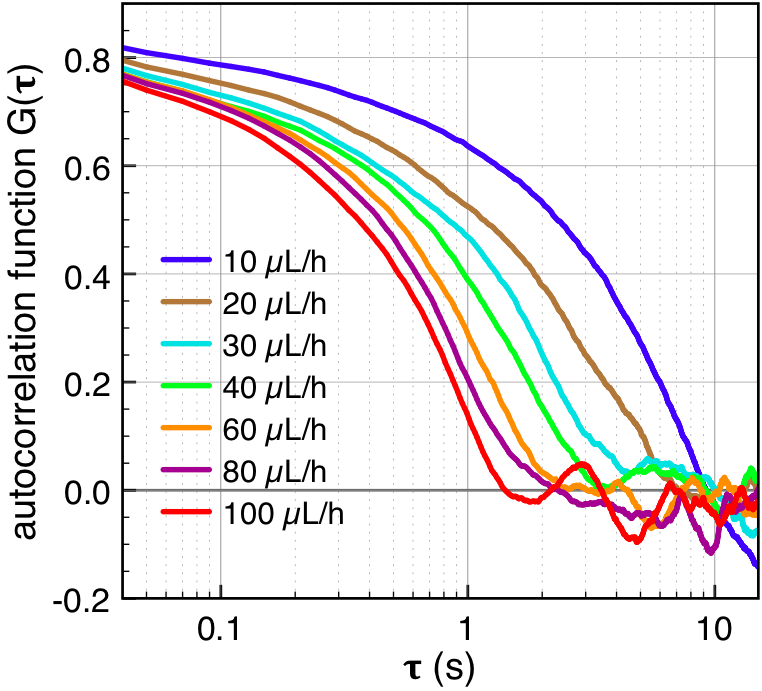
This paper reports on electrochemical autocorrelation spectroscopy as a technique to detect ultra-low liquid flow rates as well as to generally study transport of small amounts of molecules in a nanofluidic channel. The molecules undergo pronounced number fluctuations due to Brownian motion. We measure these fluctuations electrically using nanogap transducers embedded in the walls of a nanochannel. When liquid is driven through the channel, also the fluctuations are transported at the same velocity, which we detect by performing an autocorrelation analysis of current-time traces obtained at the detector. Thereby we are able to determine record-low flow rates below 1 pL/min.

Conference Proceedings

K. Mathwig, S. Kang, D. Mampallil and S. G. Lemay
Pushing the Limits of Electrical Detection of Ultralow Flows in Nanofluidic Channels
Proceeding of the 1st International Conference on Microfluidic Handling Systems, Enschede, The Netherlands, Oct. 10 – 12 (2012) 18.
[pdf]

This paper presents improvements in flow detection by electrical cross-correlation spectroscopy. This new technique detects molecular number fluctuations of electrochemically active analyte molecules as they are transported by liquid flow through a nanochannel. These fluctuations are used as a marker of liquid flow as their time of flight in between two consecutive transducers is determined, thereby allowing for the measurement of liquid flow rates in the picoliter-per-minute regime. Here we show an enhanced record-low sensitivity below 1 pL/min by capitalizing on improved electrical instrumentation, an optimized sensor geometry and a smaller channel cross section.

Journal Article

K. Mathwig, D. Mampallil, S. Kang and S. G. Lemay
Electrical Cross-Correlation Spectroscopy: Measuring Picoliter-per-Minute Flows in Nanochannels
Physical Review Letters 109 (2012) 118302.
[pdf]
→ See accompanying Focus in Physics 5 (2012) 101.
→ See also News in New Scientist 2883 (2012) 15.

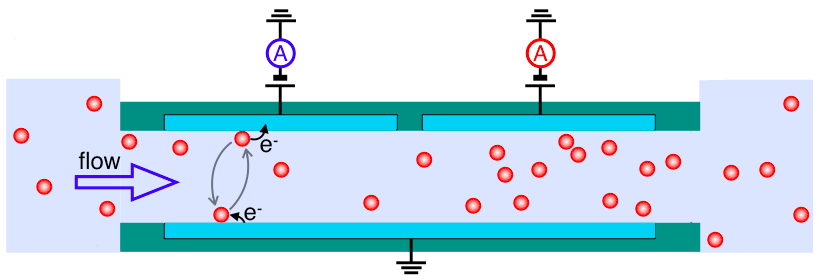
We introduce all-electrical cross-correlation spectroscopy of molecular number fluctuations in nano-fluidic channels. Our approach is based on a pair of nanogap electrochemical transducers located downstream from each other in the channel. When liquid is driven through this device, mesoscopic fluctuations in the local density of molecules are transported along the channel. We perform a time-of-flight measurement of these fluctuations by cross-correlating current-time traces obtained at the two detectors. Thereby we are able to detect ultralow liquid flow rates below 10 pL/min. This method constitutes the electrical equivalent of fluorescence cross-correlation spectroscopy.

Journal Article

L. Rassaei*, K. Mathwig*, E. D. Goluch and S. G. Lemay
Hydrodynamic Voltammetry with Nanogap Electrodes
The Journal of Physical Chemistry C 116 (2012) 10913. (*equal contribution)
[pdf]
Correction: J. Phys. Chem. C 120  (2016) 3086 [link].

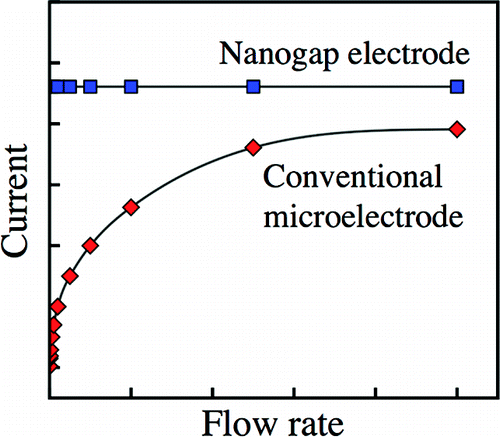
We study the influence of convective mass transport on faradaic currents detected under redox cycling conditions at nanogap electrodes embedded in a microchannel. We show that, unlike the case of microelectrodes, the limiting current in the nanofluidic device is not influenced by the sample flow rate in the microfluidic channel. This is due to both the hydraulic resistance of the nanochannel suppressing flow within the device and the inherently diffusion-based mass transport between microelectrodes separated by a 70 nm gap. These devices thus allow electrochemical measurements without the need for any flow velocity correction.

Journal Article

S. Kang, K. Mathwig and S. G. Lemay
Response time of nanofluidic electrochemical sensors
Lab on a Chip 12 (2012) 1262.
[pdf]
Lab Chip HOT article

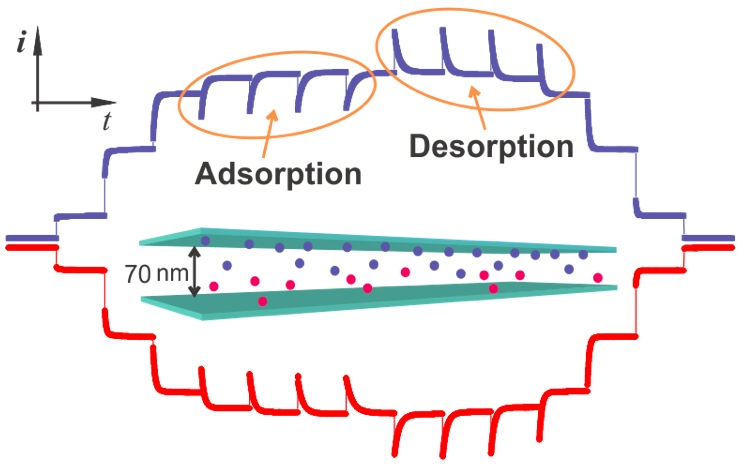
Nanofluidic thin-layer cells count among the most sensitive electrochemical sensors built to date. Here we study both experimentally and theoretically the factors that limit the response time of these sensors. We find that the key limiting factor is reversible adsorption of the analyte molecules to the surfaces of the nanofluidic system, a direct consequence of its high surface-to-volume ratio. Our results suggest several means of improving the response time of the sensor, including optimizing the device geometry and tuning the electrode biasing scheme so as to minimize adsorption.

Conference Proceedings

N. Haandbæk, K. Mathwig, R. Streichan, N. Goedecke, S. C. Bürgel, F. Heer and A. Hierlemann
Characterization of Cell Phenotype using Dynamic Vision Sensor and Impedance Spectroscopy
Proceedings of the 15th International Conference on Miniaturized Systems for Chemistry and Life Science, Seattle, USA, Oct. 2 – 6 (2011) 1236.
[pdf]

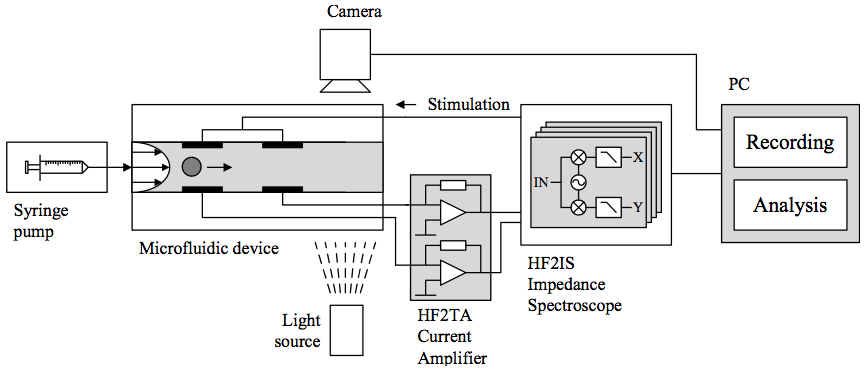
This paper reports on an improved method for characterizing single cells within a microfluidic channel, which combines the output of a Dynamic Vision Sensor camera with data from a differential impedance spectroscopy measurement. The combination of optical and impedance data allows the size, shape and position of the cells to be determined in addition to their dielectric properties. Here, we demonstrate the utility of the method by discriminating between normal and budding yeast cells.

Conference Proceedings

N. Haandbæk, K. Mathwig, R. Streichan, N. Goedecke, S. C. Bürgel, F. Heer and A. Hierlemann
Bandwidth Compensation for High Resolution Impedance Spectroscopy
Proceedings Eurosensors XXV, Sept. 4 – 7, 2011, Athens, Greece
Procedia Engineering 25 (2011) 1209.
[pdf]

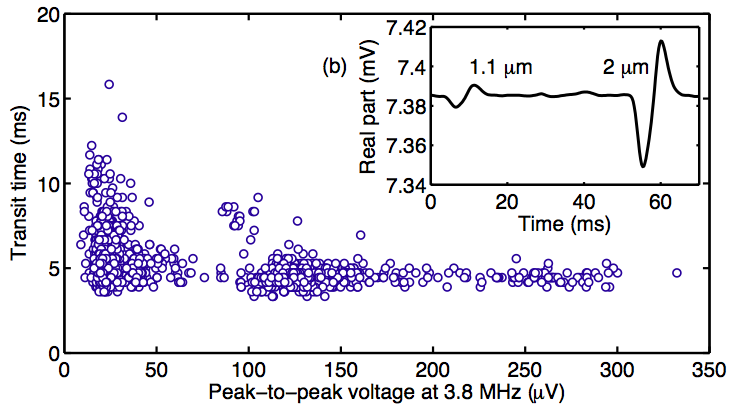
This paper reports on a microfluidic differential impedance cytometer, which uses a bandwidth compensation technique together with a small detection volume and multi-frequency analysis to achieve an increased sensitivity. The bandwidth compensation technique allows for measurements within small bandwidths by accounting for the increased signal amplitude dependence on the particle speed. We demonstrate detection and clear baseline discrimination of polystyrene beads with diameters of 1 μm and 2 μm and the discrimination of 5 μm beads from yeast cells of similar size. We show that using multiple frequencies in parallel significantly improves the discrimination performance of the cytometer.

Journal Article

K. Mathwig, F. Müller and U. Gösele
Particle transport in asymmetrically modulated pores
New Journal of Physics 13 (2011) 033038.
[pdf]
→ IOP select

Brownian motion plays an important role in the separation of small particles and molecules, but generally leads to undirected motion or intermixing by diffusion. Matthias and Müller (2003 Nature 424 53–7) reported on the experimental realization of a drift ratchet, a microfluidic particle transport mechanism that utilizes random fluctuations instead, i.e. a Brownian motor. Here, we offer a new interpretation of this previously published work on the drift ratchet. New experiments, which allow us to distinguish between particles of different sizes, as well as a re-examination of the original work, lead to the conclusion that the measured particle transport does not result from a ratchet effect. We demonstrate that the transport is caused by convection instead. While our result challenges one specific type of experiment, we do not assess the feasibility of a drift ratchet in principle. Instead, we identify the experimental conditions that need to be fulfilled for the successful separation of particles.

Journal Article

K. Mathwig, M. Geilhufe, F. Müller and U. Gösele
Bias-assisted KOH etching of macroporous silicon membranes
Journal of Micromechanics and Microengineering 21 (2011) 035015.
[pdf]
→ IOP select
→ Highlights of 2011 selection

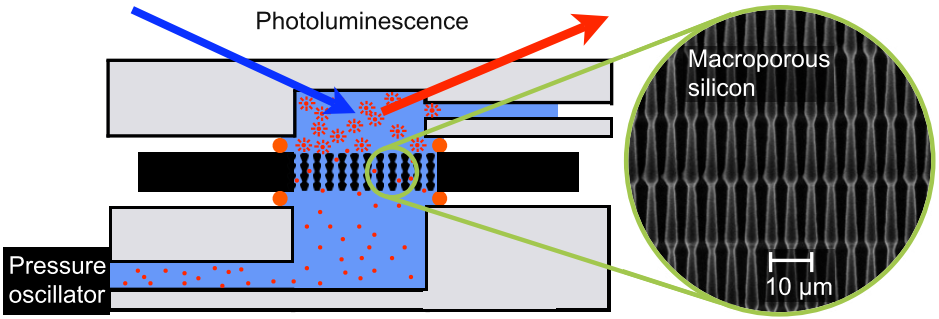
This paper presents an improved technique to fabricate porous membranes from macroporous silicon as a starting material. A crucial step in the fabrication process is the dissolution of silicon from the backside of the porous wafer by aqueous hydroxide to open up the pores. We improved this step by biasing the silicon wafer electrically against the KOH. By monitoring the current–time characteristics a good control of the process is achieved and the yield is improved. Also, the etching can be stopped instantaneously and automatically by short-circuiting Si and KOH. Moreover, the bias-assisted etching allows for the controlled fabrication of silicon dioxide tube arrays when the silicon pore walls are oxidized and inverted pores are released.

Journal Article

Y. Qin, Y. Kim, L. Zhang, S.-M. Lee, R. B. Yang, A. Pan, K. Mathwig, M. Alexe, U. Gösele and M. Knez
Preparation and Elastic Properties of Helical Nanotubes Obtained by Atomic Layer Deposition with Carbon Nanocoils as Templates
small 6 (2010) 910.
[pdf]

Helical oxide nanotubes prepared by atomic layer deposition (ALD) replicate the helical morphology of the carbonnanocoil templates. ALD is superior to other coating technologies for the high-curvature surfaces of the nanostructures in terms of conformality and thickness control. The helical nanotubes have much better elasticity than straight nanotubes.